
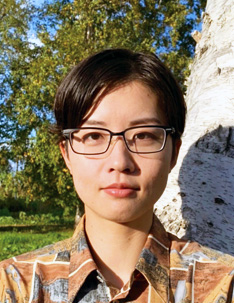
|
Affiliation |
IWATE University Faculty of Agriculture Department of Rural Environmental Sciences Course Of Forest Science |
|
Position |
Assistant professor |
|
Year of Birth |
1990 |
|
Mail Address |
|
YAMAZAKI Haruka
|
|
|

Graduating School 【 display / non-display 】
-
2009.04-2013.03
Iwate University Faculty of Agriculture Graduated
Graduate School 【 display / non-display 】
-
2015.04-2019.09
Hokkaido University Graduate School, Division of Environmental Science Doctor's Course Completed
-
2013.04-2015.03
Hokkaido University Graduate School, Division of Environmental Science Master's Course Completed
Campus Career 【 display / non-display 】
-
2020.10-Now
IWATE University Faculty of Agriculture Department of Forest Science Assistant Professor [Duty]
External Career 【 display / non-display 】
-
2019.10-2020.09
Part-Time Researcher for University or Other Academic Organization
Course Subject 【 display / non-display 】
-
2025
Biostatistics
-
2025
Forest Measurement
-
2025
Global Forestry
-
2025
Graduation Theses
-
2024
Graduation Research
Published Papers 【 display / non-display 】
-
Stand characteristics and aboveground biomass of young coastal Pinus thunbergii Parl. stands with different tree densities
Kazuhiko Masaka, Miki Watanabe, Kyohei Nitta, Hiroki Tamura, Tomonori Kaneko, Manabu Shirahata, Haruka Yamazaki, Ibuki Moriwaki
Journal of Forest Research 31 ( 1 ) 37 - 44 2025.12 [Refereed]
Bulletin of University, Institute, etc. Multiple authorship
To consider density control practices for the extra-high density Japanese black pine (Pinus thunbergii Parl.) forests, we investigated stand characteristics, aboveground biomass, and biomass production in young stands of various density during 2019–2021 (14–16 years old). We used the density-adjusted plots established in an even-aged natural forest in 2010; i.e. 1,000, 2,500, 5,000, 10,000 trees ha−1, and the control plot (ca. 50,000 trees ha−1) without thinning. Mean tree height did not differ significantly among the plots, whereas mean clear bole length was longer and mean trunk diameter was smaller with increasing tree density. Spindly tree form was observed especially in the control plot, indicating higher vulnerability to mechanical disturbances. Aboveground biomass (YTotal; Mg ha−1) in the control and 10,000 trees ha−1 plots was greater than that of the published data. These two plots were considered to reach the full density condition which is higher than the full density condition in the published data. It implies the difference in site quality among sites. Positive correlation was observed between leaf biomass (Mg ha−1), and the increment of YTotal (ΔYTotal), if the control plot was excluded. Together with the spindly tree form, it was too late for thinning in the control plot. In contrast, no thinning would be required for 1,000 and 2,500 trees ha−1 plots, since the reduction of ΔYTotal was not observed in these plots. Thinning would be required for 5,000 and 10,000 trees ha−1 plots. Further quantitative analysis will be necessary for future density control.
-
Decline of Pinus thunbergii Saplings Planted at Restoration Area of Coastal Forests: A Case Study at Iwanuma 20th Construction Area in Miyagi Prefecture.
107 ( 9 ) 199 - 207 2025.09 [Refereed]
International Conference Proceedings Multiple authorship
-
Changes of ground beetles and Araneids fauna in the forest management sites where were constructed assisted natural regeneration using heavy machinery
Tohoku Journal of Forest Science 30 ( 2 ) 99 - 107 2025.09 [Refereed]
International Conference Proceedings Multiple authorship
-
The regeneration characteristics of Juglans mandshurica var. siedoldiana - seed dispersal, germination, and the growth of annual seedlings -.
Tohoku Journal of Forest Science 30 ( 2 ) 55 - 64 2025.09 [Refereed]
International Conference Proceedings Multiple authorship
J. mandshurica var. siedoldiana is popular as furniture and craft wood, and its seeds are used by animals, and it is expected that this tree species will be able to demonstrate economic and utilitarian functions. However, the mechanisms related to the natural regeneration characteristics of this species are unclear, and it is rarely used as a silvicultural species. Our research and experiments were conducted with the aim of elucidating the suitable site environment of J. mandshurica var. siedoldiana. Seed dispersal decreased the further outward from the canopy edge of the mother tree, and was completely absent at 4 m. The spraying period was concentrated in September-October. The germination rate was 0% when not buried in soil and averaged over 80% when buried 5 and 10 cm from the surface. Regarding the growth of the seedlings, under most conditions, individuals buried 5 cm from the surface had weight of the main shoot and roots, and the length of the main shoot was 30 cm or more. A total of 224 adult walnut trees were found in the study area, but there was no significant relationship between the number of trees and the site environment. There was a relationship between forest phase and elevation with respect to DBH. It is necessary to implement and verify the methods of management (natural regeneration and artificial silviculture) for J. mandshurica var. siedoldiana, taking into consideration the above results, while promoting more appropriate surveys of the growing environment.
-
Predicting the Size Distribution of Lacquer Tree Plantations Based on Y-N Theory and Estimation of the Maximum Yield of Urushi Sap at Stand Level
106 ( 7 ) 190 - 197 2024.11 [Refereed]
Academic Journal Multiple authorship
Association Memberships 【 display / non-display 】
-
2025.01
Japan Society of Forest Planning
-
2020.12
Japan Forest Technology Association
-
2020.10
The Tohoku Society of Forest Science
-
2013.04
The Japanese Forest Society
-
2013.04
The Ecological Society of Japan
Academic Activity 【 display / non-display 】
-
2022.02-2022.03
The Japanese Forest Society